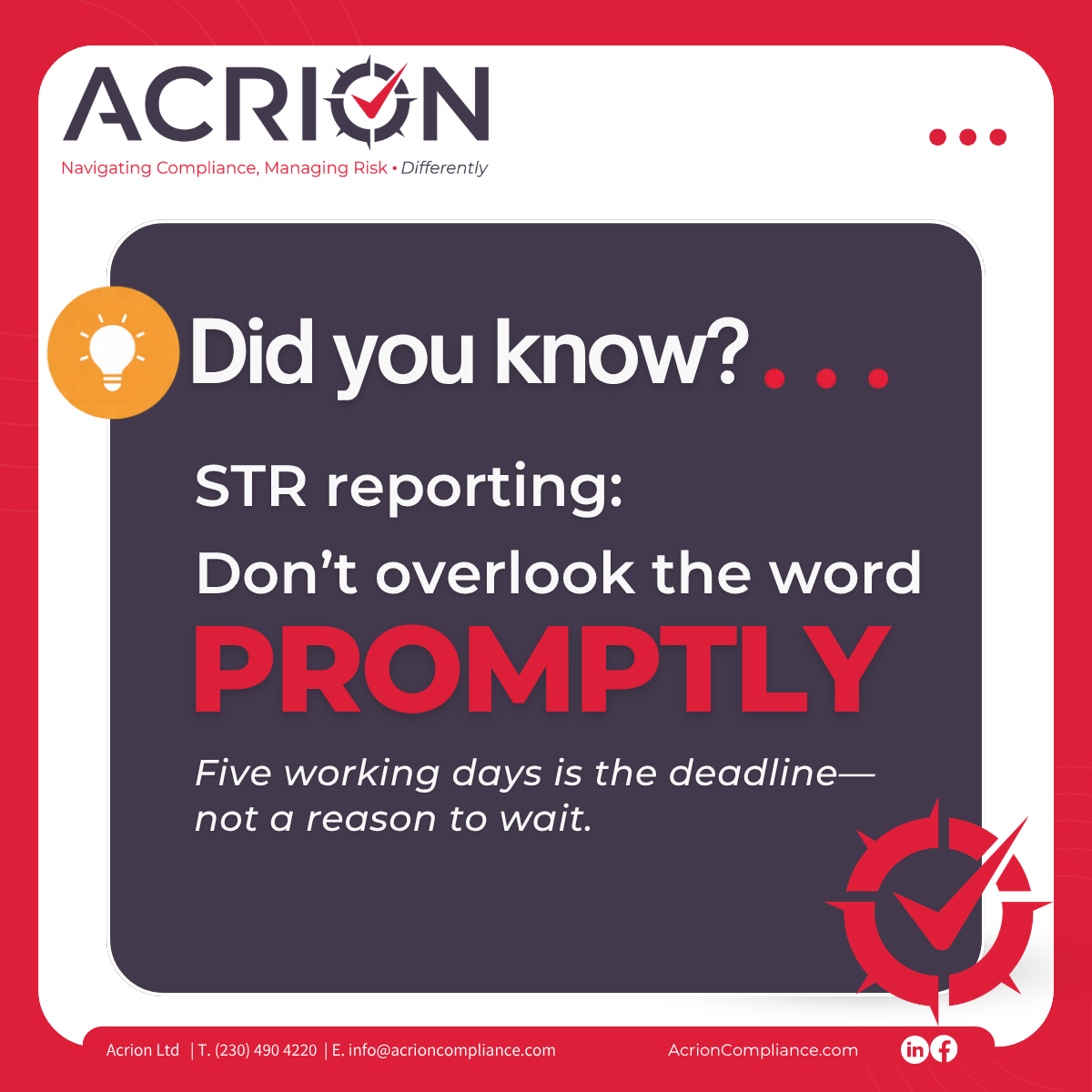
Did you know that reporting a suspicious transaction within five working days does not necessarily mean you have reported it promptly?
Your AML/CFT manual mentions five working days. But does it mention “promptly”?
During our AML/CFT audits, we have come across manuals that refer to section 14(1) of FIAMLA but leave out this important word—even when reproducing the reporting requirement.
One word omitted. An important part of the obligation overlooked.
Section 14(1) requires every reporting person or auditor, upon becoming aware of a suspicious transaction, to report it to the FIU “promptly but not later than 5 working days after the suspicion arose”.
So, what does “promptly” mean in practice?
The FIU’s Supplementary STR Guidance Note 4.1, effective from 19 August 2026, clarifies that:
▪️ An STR should be submitted on the same day where reasonably practicable, once the MLRO/DMLRO determines that reasonable grounds for suspicion exist.
▪️ More complex cases should be reported within the shortest possible time, subject to the five-working-day limit.
▪️ Delays caused by insufficient staff or IT resources are not acceptable.
The FIAML Regulations 2018 reinforce this urgency: regulation 27(f) requires procedures enabling reporting as soon as practicable, while regulation 29(2) requires the MLRO to report forthwith when the specified suspicion threshold is met.
Omitting “promptly” from a manual does not remove the obligation to act without unnecessary or avoidable delay.
At Acrion, our independent AML/CFT audits assess whether policies and procedures accurately reflect regulatory requirements and support their effective implementation. We identify gaps and provide practical recommendations to strengthen your compliance framework.
Does your STR procedure communicate the urgency—or only the deadline?
📩 info@acrioncompliance.com
Navigating Compliance. Managing Risk. Differently