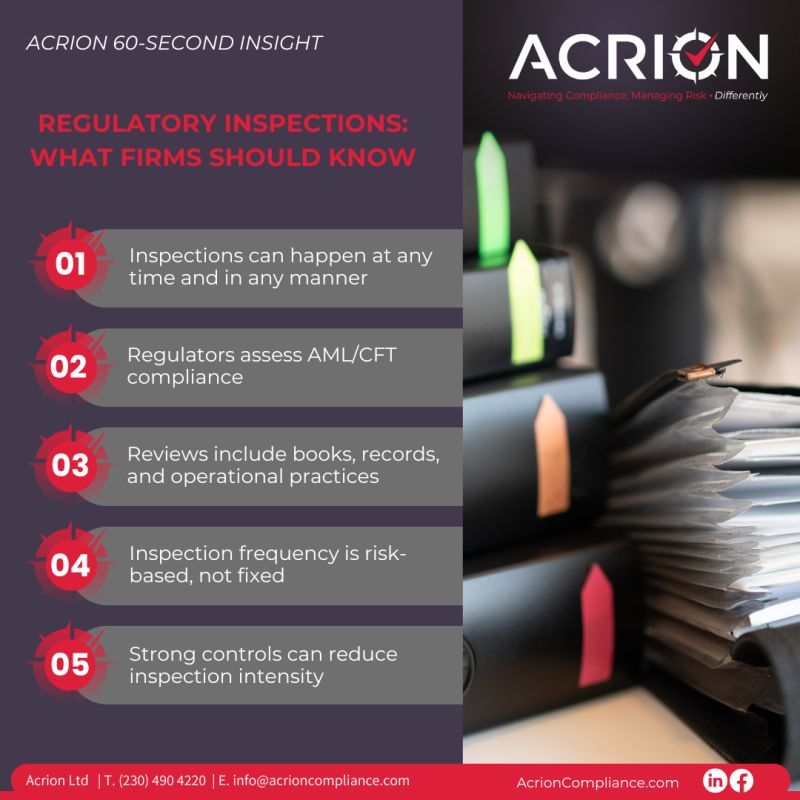
Under the Financial Services Act, the regulator has the authority to inspect a licensee at any time, review its business activities, and audit its books and records to assess compliance with AML/CFT laws, licence conditions, and regulatory standards.
Here’s what that means in practice:
1️⃣ Inspections can happen at any time
There is no fixed inspection calendar. Firms should operate on the assumption that their compliance framework must be inspection-ready at all times.
2️⃣ AML/CFT compliance is a central focus
Inspectors assess whether policies are not only in place, but implemented effectively in line with legislation, regulations and guidelines.
3️⃣ Documentation matters
Books, records, client files, and internal controls are reviewed to test consistency between what is documented and what is actually applied.
4️⃣ Frequency is driven by risk
The regulator determines inspection frequency and intensity based on:
• The firm’s ML/TF risk profile
• The effectiveness of its internal controls
• The nature, size, and complexity of its activities
5️⃣ Strong governance reduces regulatory pressure
Firms with robust risk frameworks, timely file reviews and well-documented controls are more likely to experience smooth inspections.
The key takeaway?
Regulatory inspections are not just about compliance — they are about preparedness.
According to the FSC’s annual report, 25% of cases referred to the Enforcement Committee is for AML/CFT deficiencies.
Acrion supports firms with inspection readiness reviews, AML/CFT gap assessments, file reviews and remediation support, helping ensure that what you say you do is exactly what the regulator sees.
📩 Speak to Acrion to strengthen your inspection readiness.
Navigating Compliance. Managing Risk. Differently